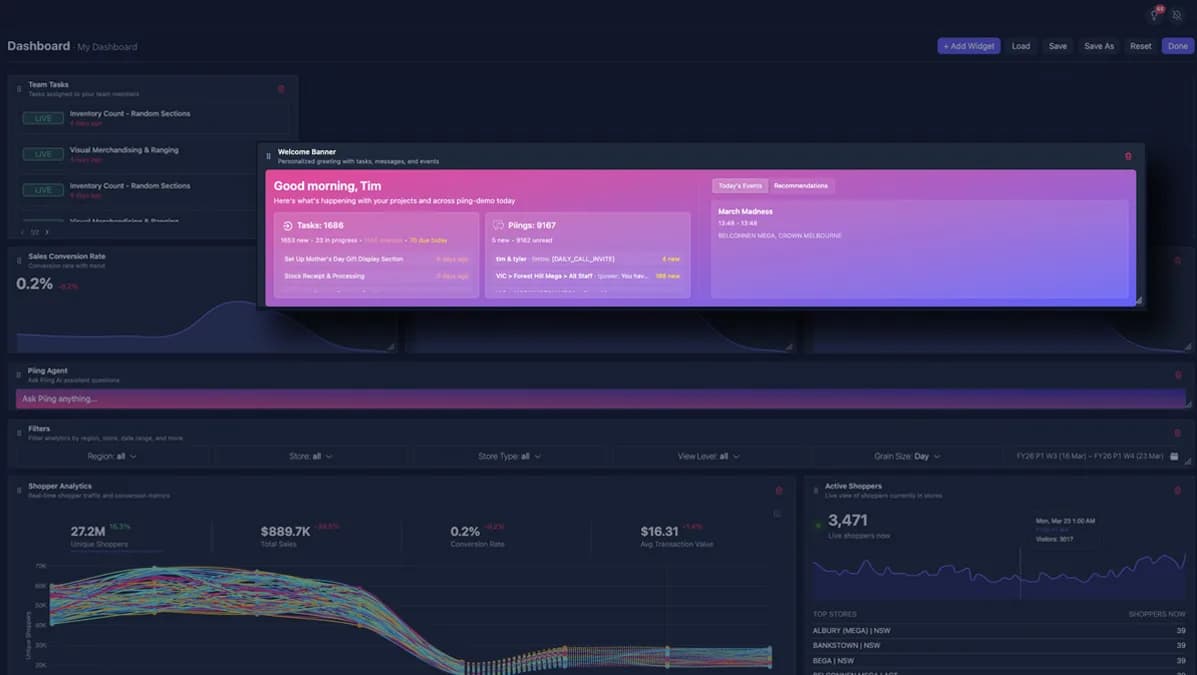
Marked done isn't done. And done isn't the same as worked.
Retail runs on tasks marked complete. But marked done isn't done, and done isn't the same as worked. The three levels of execution truth — and why most retailers only ever see the first.
Somewhere in your business right now, a task is turning green.
A store manager has ticked off the new window display. On a screen at head office, a number moves: 94% complete, on track, looking good. Everyone exhales. The rollout worked.
Except you don't actually know that. You know a box got ticked. You don't know if the display went up the way it was meant to, whether it went up in the right stores, or whether a single extra customer bought a single extra thing because of it.
You've been handed a colour, and you've agreed to treat it as the truth.
This is the quiet problem at the heart of running stores at scale. Retail has spent a decade buying tools to make work visible: task apps, checklists, comms platforms. And they've helped. But almost all of them stop at the same place. They confirm a task was marked done. They were never built to tell you whether it was actually done, and they can't begin to tell you whether it worked.
There are three levels of execution truth. Most retailers only ever see the first.
Level one: reported
This is the tick. The task marked complete, the checklist submitted, the green cell on the dashboard.
Reported execution is easy to collect and comforting to look at, which is exactly why the whole category is built on it. A 2026 survey of 227 retail leaders found HQ rates its own understanding of store operations at 9.1 out of 10. The store leaders rate HQ's understanding at 5.7. That gap, nearly three and a half points on the same stores in the same week, is the gap between what gets reported and what's real.
Reported is not nothing. But it's a promise, not a fact. And you're running your most expensive channel on promises.
Level two: verified
This is proof the work was actually done, the way it was meant to be done.
A photo of the finished display, not a tick that says "display: complete". A timestamp. A record you could put in front of the person who briefed it and have them say yes, that's right, or no, that's not what I asked for.
Verification is a real step up, and the better tools in the category reach it. It closes the gap between "someone said it's done" and "it's done." It catches the store that ticked the box and moved on. It's the difference between hoping and knowing.
But verification still only tells you the work happened. It doesn't tell you the work mattered. And that's the level where all the money is.
Level three: proved
This is the one almost nobody reaches: did it work?
Not "was the display built" but did the stores that built it sell more than the stores that didn't? Did conversion move? Did the promo actually lift the basket, or did it just move stock that would've sold anyway? When you rolled that initiative to 200 stores, which of them turned it into revenue, and which went through the motions?
That's proved execution. It's the difference between an action and an outcome: between a store that's busy and a store that's earning.
Here's why it matters so much. The same 2026 survey found only 36% of retailers say more than three-quarters of their initiatives execute correctly and on time. And 43% say poor execution has directly cost them sales. Nearly half of retail leaders can name lost revenue they'll never recover, and their tools told them everything was green the whole time.
You cannot fix a problem your system is designed not to see.
Why the gap exists, and why it isn't the frontline's fault
It would be easy to read all this as "stores don't execute." That's the wrong lesson, and it's the lazy one.
Store teams want to do a great job. They're asked to run fifteen priorities across a shifting floor, with people who change shift by shift, on instructions that arrive by email and WhatsApp and get interpreted fifteen different ways. When execution breaks, it's almost never because someone didn't care. It's because nobody gave them the context to get it right, and nobody gave you the context to see what actually happened.
That same survey makes the point plainly: the single most-cited reason initiatives fail isn't laziness or defiance. It's not enough staff to do the work. The people are stretched. The system around them was never built.
So the fix isn't to push harder on the frontline. It's to stop running the floor blind.
What "proved" actually takes
Getting to level three isn't a better checklist. It's a different kind of record.
To prove an action worked, you have to connect it to an outcome: wire what happened on the floor to what happened at the till. The window reset, tied to that store's traffic and conversion that week. The compliance push, tied to the basket. The initiative, tied to the gap between the stores that did it well and the stores that didn't.
Do that across a whole network and something changes. You stop guessing which of your stores are actually good and which just have good postcodes. You watch the same brand, same range, same prices spread across a four-fold performance gap, and for the first time you can see that the difference isn't the market. It's what happens on the floor. And now you can find it, name it, and roll the winning version everywhere.
That's not a dashboard. It's a record of your stores that finally tells the truth: reported, verified, and proved.
The scoreboard is wrong
If your store tooling can only tell you what was marked done, you're keeping score with the wrong number. You're measuring effort and calling it results.
Marked done is a promise. Done is a fact. Worked is the only one that pays.
Most of retail has settled for the first and occasionally reaches the second. The retailers who get to the third, the ones who can prove what their stores actually earned, will run circles around the ones still watching cells turn green.
Piing is the context engine for retail: it turns store-floor reality into a structured, real-time record, and connects every action to the outcome it drove. You see not just what was marked done, but what it earned. *See your estate come alive →*
See what your network is actually doing today.
A working session on one network: where the performance is leaking, and what the measurement would have to show to prove it closed.