The store data blind spot: your biggest channel is your darkest

Your stores make around 80% of the revenue and almost none of the data. The floor is retail's biggest blind spot — here's what goes dark, what it costs, and how to turn store reality into a record that tells the truth.
A regional manager sends a brief on Thursday night. New end-of-aisle display, new price on the hero line, refresh the front table for the weekend. It goes to a hundred and forty stores at once. By Monday, the group chats have gone quiet and the week has moved on.
Somewhere in those hundred and forty stores, the brief landed. In some of them it went up clean on Friday morning. In some it went up Saturday afternoon, half-right, because the stock hadn't arrived. In a few it never went up at all. The manager was covering two sections and it slipped. And you will never know which was which. The brief went out into the floor and the floor closed over it like water.
That's the store. Your biggest channel, and your darkest. Instructions go in; nobody knows what comes out.
The asymmetry
Here is the strange thing about how retail measures itself. Every channel is wired for context except the one that makes the money.
Your website knows everything. Every click, every hover, every abandoned cart, every path a shopper took to the checkout and every point they fell off it. If conversion dips half a point on a Tuesday, someone can tell you why by lunch. The channel narrates itself, minute by minute.
Your supply chain knows everything too. Every pallet has an ID. Every truck has a location. You can follow a single case of product from a distribution centre to a back-room door and timestamp every hop it made. The whole spine of the business is instrumented, because someone decided decades ago that not knowing where the stock was cost too much.
Then there's the store. Around 80% of the revenue, the vast majority of what the business actually earns, runs across a floor you can barely see. The channel that matters most is the one you understand least. Every other part of retail narrates itself in real time. The store stays silent.
This is the store data blind spot, and it isn't a small one. Coresight Research's State of In-Store Retailing 2025 found only about a quarter of retailers have full visibility across their store-related functions. Read that the other way: three in four are running their most valuable channel partly in the dark, and they know it.
What actually goes dark
What you lose when the floor goes silent is more than a missing photo.
You lose what actually happened. The brief said one thing; a hundred and forty stores did a hundred and forty slightly different things with it, and the differences are invisible. Not because anyone lied, but because there was never a place to write down what was really done.
You lose why it landed differently. One store had the stock and a full roster; the next had neither. One manager read the brief as "priority"; another read it as "when you get to it." The context that shaped the outcome (staffing, stock, timing, how the instruction was even understood) never gets recorded, so the variation looks like noise instead of the signal it is.
You lose what it cost. Someone spent two hours rebuilding that display. Multiply by a hundred and forty stores and you've spent real money and real labour, and none of it shows up anywhere you can add it back. The effort is real; the record of it isn't.
And you lose which stores executed. When the weekend numbers come in, you can't sort the stores that ran the play from the stores that went through the motions. You've got a result and no way to trace it back to what was done to earn it.
None of this is exotic. Coresight and Simbe's 2024 work found that somewhere between 88% and 96% of retailers report ongoing challenges across in-store operations: out-of-stocks, price and promotion execution, planogram compliance. These are the everyday things stores are asked to get right. Nearly all retailers say they struggle with them. Almost none can see them clearly enough to say where, or why.
The cost of the blind spot
You can't fix what you can't see. That's the whole cost, and it shows up in three ways.
Performance gaps stay mysteries. Two stores, same brand, same range, same prices, and one does half the numbers of the other. Is it the catchment? The manager? The way the floor gets run on a Saturday? Without a record of what actually happens in each, you're guessing, and you'll probably blame the postcode, because the postcode is the only thing you can measure. The real difference is on the floor, and the floor is exactly what you can't see. (This gap is worth a whole piece on its own: Why identical stores perform differently.)
You find out too late. The blind spot is also a time delay. By the time a failed rollout shows up in the sales data, the promotion is over, the labour is spent, and the window to do anything about it has closed. You learn that something went wrong weeks after you could have fixed it.
The losses are real and nameable. A 2026 survey of 227 retail leaders found that 43% could point to sales they'd lost directly to poor execution, and only 36% said more than three-quarters of their initiatives execute correctly and on time. The second number is the quiet one: most retail leaders can't say with confidence that most of their initiatives land. Not because their people are failing, but because nobody can see clearly enough to know.
Why it stayed dark this long
It's tempting to call this neglect. It isn't. The floor stayed dark because the floor is genuinely hard to instrument, in a way a website never was.
A website is already digital. Every action is already an event; capturing it is almost free. The store is the opposite. It's physical, it's human, and it changes shift by shift. The work is a person kneeling to build a display, a conversation at a service desk, a judgement call about where to put the stock that came in late. None of that throws off a clean signal on its own. There's no event log for a shelf.
And the people on that floor were never given a way to leave a record. They were handed the brief and the checklist: tools built to push work down, not to capture what came back up. A tick in a box was the most they could send, and a tick tells you almost nothing. So the darkness was never the teams' fault. They were doing hard, careful work with no instrument to write it down, and the system above them mistook their silence for a lack of anything worth hearing.
That's why the blind spot lasted. Not because it didn't matter. Because closing it was hard, and for a long time nobody had a way.
The fix: turn the floor into a record
The fix isn't another dashboard bolted over the same silence. It's to change what the floor produces: make store reality leave a structured, real-time record as the work is done, instead of vanishing the moment the shift ends.
That means capturing the floor as context: what was done, where, when, by whom, and in what conditions. The stock, the staffing, the way the brief was read. Not a tick, but the texture of what actually happened. Then it means wiring that record to outcomes, so the display that went up clean on Friday can be told apart from the one that went up half-right on Saturday, and both can be told apart in the numbers they drove.
Do that, and the darkest channel starts to narrate itself the way the website already does. The variation stops being noise. The mystery stores become legible. And the 80% of your revenue that's been running silent finally has a voice you can hear, in time to act on it.
The store is where context goes to die. It doesn't have to be.
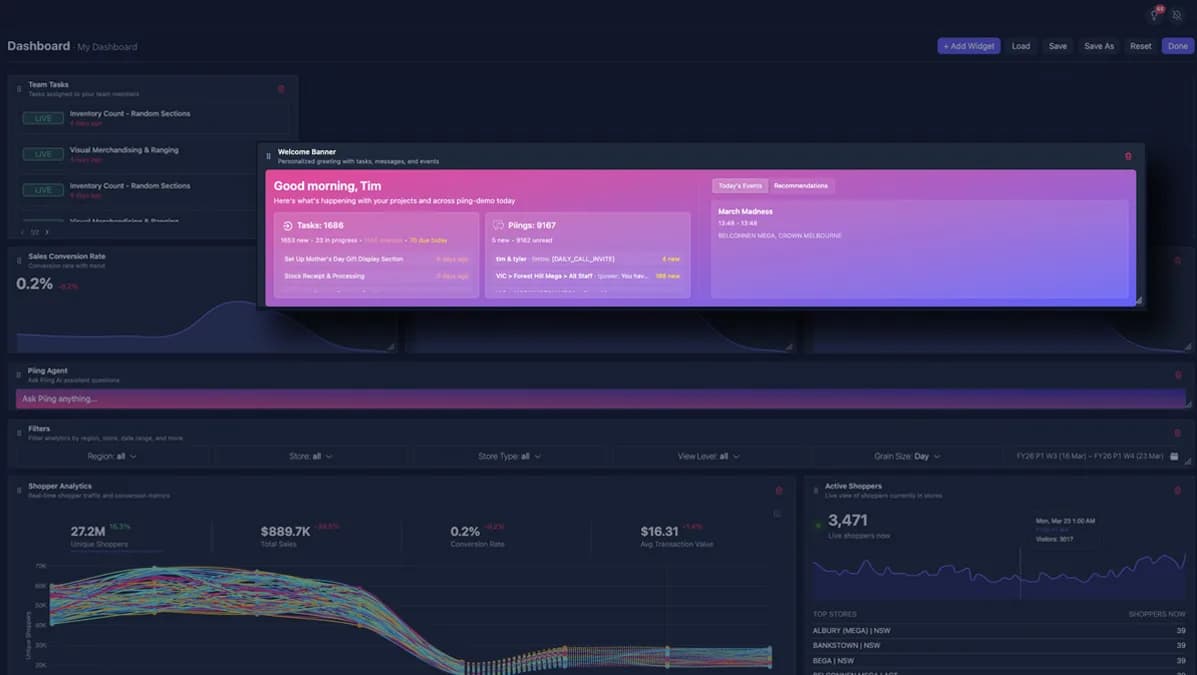
Piing is the context engine for retail: it turns store-floor reality into a structured, real-time record, and connects every action to the outcome it drove. Your biggest channel finally stops running in the dark. *See your estate come alive →*
See what your network is actually doing today.
A working session on one network: where the performance is leaking, and what the measurement would have to show to prove it closed.