What is retail execution? A guide for retailers (not brands)

Retail execution is getting HQ's plans actually and consistently done across every store — and knowing whether they worked. A plain guide for retailers running their own store networks, not brands sending reps into someone else's.
Retail execution is getting head office's plans (merchandising, promotions, compliance, store standards, everyday tasks) actually and consistently done across every store, and knowing whether they worked. It's the whole distance between a decision made at HQ and that decision landing the same way on 200 shop floors. Not the plan. The plan, done, everywhere, and proved.
Most of what's written online about "retail execution" doesn't mean this. It means something narrower, and it's aimed at someone else. We'll clear that up first, because it changes everything that follows.
Retailer-side vs. CPG field sales: name the difference
Search "retail execution" and nearly every result is written for CPG brands: a beverage or snack company sending field reps into stores they don't own, to check that their product is on the shelf, priced right, and stocked the way the trade deal promised. That's real work. But it's execution seen from the outside in: one brand, its own SKUs, someone else's floor.
This guide is about the other side: you run the stores. You're a retailer with a network of your own, and retail execution means getting your whole floor right, every category, every promotion, every standard, every task, in every location, every week. Same two words, completely different job. When the plan is yours and the floor is yours, execution isn't about auditing one brand's shelf. It's about whether the business you designed at HQ is the business your customers actually walk into.
Hold that distinction. Almost all the tooling and advice out there is built for the brand-rep version. The retailer-side problem is bigger, and worse served.
What retail execution includes
For a retailer, execution covers everything HQ pushes to the floor:
Merchandising and resets. Planograms, ranging, seasonal changeovers, the new window.
Promotions. The price change live on the right day, the display built, the stock in position.
Compliance and store standards. Safety, food handling, brand look, the things that must be true in every store, always.
Tasks and rollouts. The fifteen priorities landing on the floor this week, from a new returns process to a supplier trial.
All of it shares one shape: a decision is made centrally, and then a person on a shop floor has to turn it into something real: correctly, on time, the same way as the store down the road.
Why retail execution is hard
It's tempting to read a missed reset as "the store didn't do its job." That's the wrong lesson, and the lazy one. Execution is hard for reasons built into the floor itself.
The floor keeps moving. A store isn't a server. Stock shifts, customers arrive, a delivery runs late, someone calls in sick. The plan written in a calm office meets a floor that never holds still.
Staffing is the number-one blocker. In a 2026 survey of 227 retail leaders, the most-cited reason initiatives fail wasn't laziness or defiance. It was simply not enough staff to do the work. The people are stretched thin, running more priorities than there are hours.
The instructions arrive as noise. Plans go out by email, WhatsApp, a printout, a phone call, and get interpreted fifteen different ways across fifteen stores. Nobody set out to run a network this way. It's just what accumulates.
The result is a familiar gap. In that same survey, only 36% of retail leaders said more than three-quarters of their initiatives execute correctly and on time. And 43% said poor execution had directly cost them sales. Nearly half can name revenue they lost, and their tools mostly told them everything was fine.
How retail execution is measured: the three levels
Here's the trap: most retailers measure execution by counting ticks. A task gets marked complete, a number moves at head office, everyone exhales. But a tick is a promise, not a fact, and a fact isn't the same as a result. There are three levels of execution truth, and most retailers only ever see the first.
Reported. The task was marked done. The box ticked, the checklist submitted, the cell turned green. Easy to collect, comforting to look at, and no proof of anything.
Verified. The work was actually done, the way it was meant to be. A photo of the finished display, a timestamp, a record you could put in front of the person who briefed it. This closes the gap between "someone said so" and "it happened."
Proved. The work mattered. The stores that built the display sold more than the stores that didn't. The action is wired to the outcome it drove.
Almost everyone stops at reported. The better tools reach verified. Proved is where the money is, and it's the level nobody's scoreboard is built to show. (We make the full case for these three levels in Marked done isn't done. The short version: marked done is a promise, done is a fact, worked is the only one that pays.)
The KPIs that matter
Four numbers tell you most of the truth:
Execution / completion rate. Of what HQ pushed out, how much actually got done? Useful, but only if it's verified completion, not ticks. A high tick rate over an unverified floor is a comforting lie.
Time-to-compliance. When you push a change, how long until every store is actually doing it? A rollout that reaches full compliance in two days is a different business from one that takes three weeks.
Store-vs-store variance. Same brand, same range, same prices, and yet your best store executes at a level your worst can't touch. Variance is where the hidden money lives: close the gap and you lift the whole network toward the top, not the average. (This one's big enough to have its own guide: Why identical stores perform differently.)
Revenue per executed action. The one almost nobody measures. Not "did we do it" but "what did doing it earn?" Tie the reset to conversion, the promo to the basket, the standard to the till. Until you can, you're measuring effort and calling it results.
The first three tell you whether the floor moved. The last one tells you whether it was worth moving, and it's the number that separates a store that's busy from a store that's earning.
FAQ
What is retail execution?
Retail execution is getting head office's plans (merchandising, promotions, compliance, standards, and tasks) done correctly and consistently across every store, and knowing whether they worked. For a retailer, it's the whole distance between a decision made at HQ and that decision landing the same way on every shop floor. It's not the plan; it's the plan, done, everywhere, and proved.
What's the difference between retail execution and retail task management?
Retail task management is one piece of retail execution: sending work to stores and collecting the ticks that say it's complete. Retail execution is the larger job: not just dispatching the task, but confirming it was actually done right and understanding whether it moved the business. Task management can tell you a box was ticked; execution is about whether the work happened and whether it mattered.
How do you measure retail execution?
Across three levels: reported (the task was marked done), verified (it was actually done the way it was meant to be), and proved (it drove a real outcome). Most retailers only see reported ticks. The KPIs worth tracking are verified completion rate, time-to-compliance, store-vs-store variance, and revenue per executed action.
Why does retail execution fail?
Usually not because the frontline doesn't care. It fails because the floor keeps moving, because instructions arrive as scattered noise across email and WhatsApp, and, most often, because stores don't have enough staff to do the work. In a 2026 survey of 227 retail leaders, insufficient staffing was the single most-cited reason initiatives fail.
What is retail execution software?
Retail execution software, sometimes called store execution software, helps a retailer push plans to every store, confirm the work was done, and, at its best, connect each action to the outcome it drove. It overlaps with retail task management software but goes further: task management stops at collecting ticks (reported) or photos (verified); execution software worth the name proves what the floor actually earned, not just what was marked done.
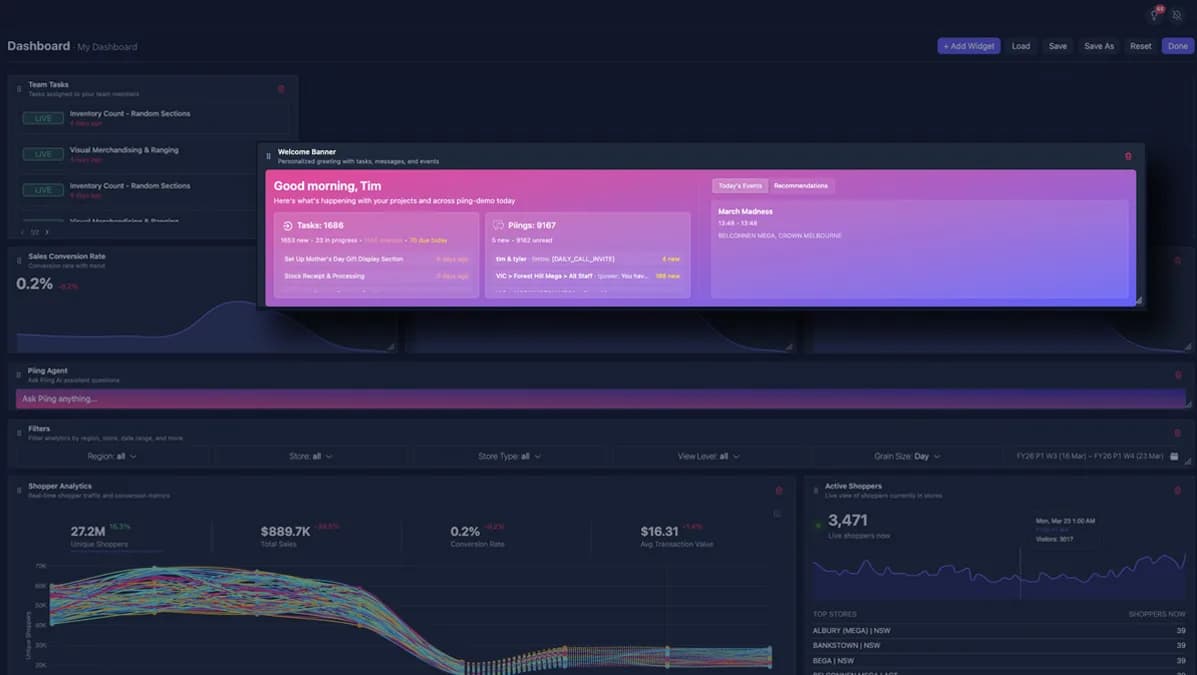
Piing is the context engine for retail: it turns store-floor reality into a structured, real-time record, and connects every action to the outcome it drove. You see not just what was marked done, but what it earned. *See your estate come alive →*
See what your network is actually doing today.
A working session on one network: where the performance is leaking, and what the measurement would have to show to prove it closed.